Artificial intelligence is changing how people discover products online. Rather than searching through a list of blue links, shoppers are increasingly asking AI assistants, search engines and conversational shopping tools for personalised product recommendations.
This shift is creating a new challenge for ecommerce website owners – optimising for AI search and agentic shopping in particular.
While traditional SEO remains essential, ecommerce businesses now need to ensure their products, website and data can be understood, trusted and recommended by AI agents.
The good news is that much of the foundation already exists. Businesses with strong technical SEO, well-structured product data and high-quality product information are already ahead of the curve. However, there are several emerging technologies and areas of optimisation that ecommerce websites should begin preparing for now.
This guide explains the fundamentals of ecommerce GEO, what you should prioritise today, and how to start measuring your progress.
Key takeaways
If you read nothing else, the below tips cover the core information you need:
- Build on solid ecommerce SEO foundations. AI search relies on websites being technically accessible, crawlable and easy to understand.
- Implement comprehensive product structured data. Rich schema markup helps AI systems understand your products, pricing, availability and reviews.
- Optimise your Google Merchant Center feed. High-quality product data is extremely important for providing AI search with accurate information.
- Prepare for emerging commerce standards. Universal Commerce Protocol (UCP) and conversational commerce are likely to play a growing role in AI-powered product discovery.
- Measure technical readiness as well as traffic. Monitor AI crawler activity, structured data health and Merchant Center performance alongside traditional SEO metrics. If one of these underperforms or worsens, so will your AI visibility.
- Treat GEO as part of your wider search strategy. Success comes from combining technical SEO, content, product data and digital marketing rather than treating AI optimisation as a standalone activity.
What is ecommerce GEO?
Generative Engine Optimisation (GEO) is the process of helping AI-powered search engines and assistants to understand and trust your content – and, from an ecommerce perspective, to therefore recommend your products.
AI systems interpret the entirety of the topic’s relevant content, from multiple sources, before generating answers or product recommendations. They look for accurate product information, structured data, trustworthy content and credible signals that demonstrate expertise.
Although GEO is evolving quickly, the underlying principles remain familiar: make your brand trustworthy, your products easy to find, and easy to understand.
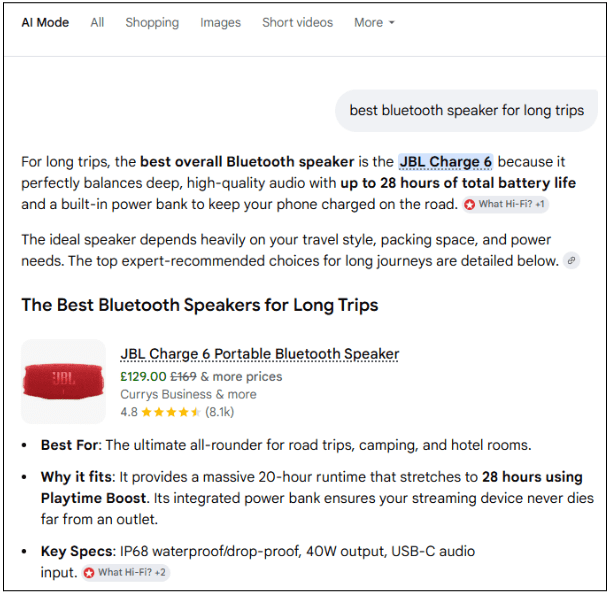
Google AI Mode
In Google’s AI Mode, the answer provides links to products, and sorts them based on how well it thinks it will meet your requirements. It additionally shows important information such as price, discounts, and the average user review for the product. Crucially, it also references a retailer where it recommends you to make the purchase.
ChatGPT
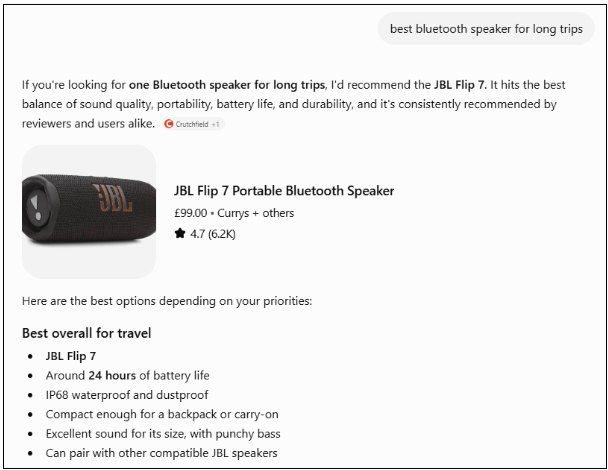
ChatGPT provides a similar experience, offering recommended products in a prioritsed order based on how well it thinks it will fit your needs. Again, it includes links to product retailers, and shows the price on that retailer’s website – along with the average user rating for the product itself.
Optimising for ecommerce GEO
The fundamentals of AI crawlability and technical ecommerce SEO/GEO
We mention technical foundations first, because without a site that can easily be crawled and indexed, the rest of your optimisation methods become irrelevant. Before AI can recommend your products, it first needs to access and understand your website.
Much like for SEO, AI search still relies heavily on traditional web crawling. If your website presents technical barriers to search engines, those same issues can also affect AI discovery.
Some of the most important technical foundations include:
- Clean site architecture with logical product groupings and categorisation
- Fast page loading speeds and strong Core Web Vitals
- Crawlable product pages that don’t rely on JavaScript
- Correct canonical tags to avoid duplicate product content
- XML sitemaps that include your entire product catalogue
- Consistent internal linking across categories and products
- Accurate robots.txt and crawl directives
- Well-maintained product pages with unique well-written (and optimised!) descriptions
These technical SEO fundamentals continue to underpin both traditional search visibility and AI search performance. In competitive ecommerce markets, businesses that neglect website performance may find they struggle to have their products surfaced not only by search engines, but by AI assistants too.
Once your technical foundations are in place, the next step is ensuring your product information can be interpreted accurately by AI systems.
This largely comes down to the quality, completeness and consistency of your product data – but we’ll look at each section individually.
Structured data for products
Structured data (also known as schema markup) provides machine-readable information that helps search engines and AI models understand the content of a page.
For ecommerce websites, Product schema is one of the most important optimisation opportunities. If you’re not sure what ‘schema’ is, Google’s Product structured data documentation explains the required and recommended properties.
Most ecommerce CMS’ implement product schema by default. However, just because it’s implemented, doesn’t mean it’s “good” or well optimised.
While implementations vary depending on your ecommerce platform, a typical product page should include as much structured information as possible. The most important schema properties are detailed below:
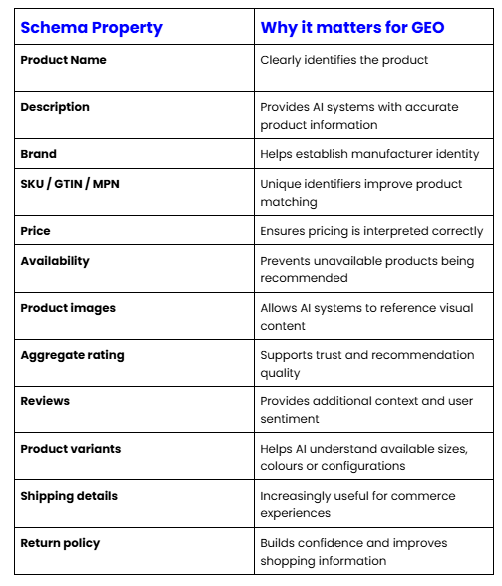
Once implemented, you can validate your markup using Google’s Rich Results Testing tool.
The more complete and accurate your structured data, the easier it becomes for AI systems to confidently interpret your products.
Product image optimisation
Images play an increasingly important role in AI-powered product discovery.
Optimising product imagery doesn’t just mean reducing file sizes, it also plays a role for discoverability in terms of AI recognising the product based on its visuals. AI systems increasingly analyse images to better understand products, identify attributes and improve shopping recommendations. Higher quality images can give you an advantage not only in terms of providing better information for customers, but also for AI crawlers too.
Best practices include:
- High-resolution product photography
- Multiple product angles
- Lifestyle imagery alongside pack shots – show the product being used
- Descriptive image filenames
- Meaningful alt text
- Consistent aspect ratios
- Fast-loading, compressed images
- Images that accurately reflect product variants
Images should reinforce the information provided within your product data rather than contradict it.
Google Merchant Center and Shopping Feed optimisation
For ecommerce retailers, if you’re not already making the most of your Google Merchant Center feed, then you’re already behind your competition.
The shopping feed has become one of the most important sources of structured product information, from both an organic and paid search perspective. Rather than treating the feed as a one-off export from your ecommerce platform, it should be actively managed and optimised.
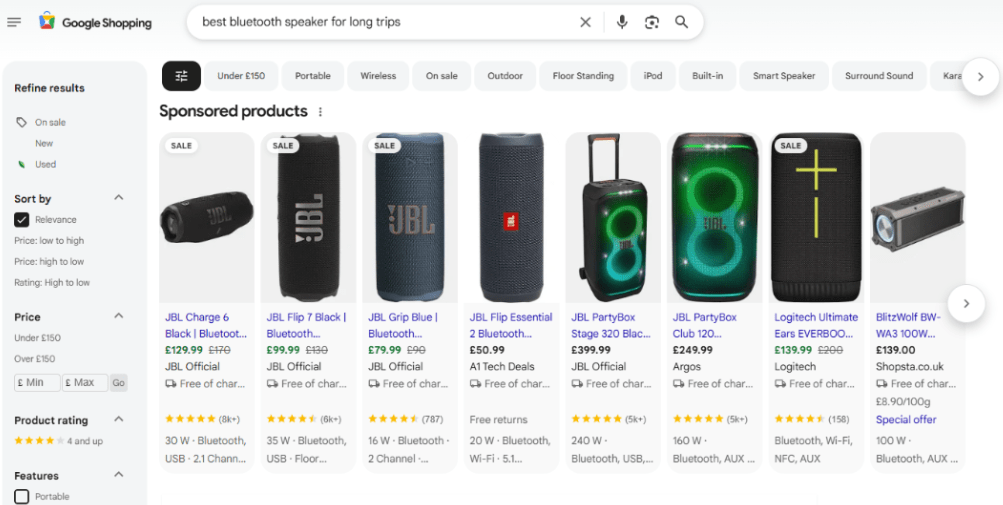
Google’s Product Data Specification explains every required (and optional) attribute – full list below, but just because an attribute is optional doesn’t mean you should ignore it – the more information the better!
Key attributes for optimisation in your shopping feeds include:
- Accurate product titles
- Detailed product descriptions
- Correct GTINs, SKUs and identifiers
- Comprehensive product attributes
- Up-to-date pricing
- Accurate stock availability
- High-quality images
- Correct product categorisation
- Rich optional attributes wherever possible
In other words, if it’s a key piece of information about the product that a customer might want to know, then it should be in the feed.
High-quality shopping feeds not only provide great data for Google’s shopping systems, it also provides stronger signals and detailed information that AI search platforms can utilise.
Conversational shopping feed attributes
Google has recently introduced conversational attributes to help AI systems better understand products beyond traditional feed data.
These optional attributes allow retailers to provide richer information that supports AI-powered shopping experiences, helping answer more natural customer questions and improve recommendation quality.
Examples include:
- Product highlights
- Key features
- Material information
- Colour attributes
- Size information
- Sustainability information
- Product Q&A
- Supporting documentation
- Related products
The more descriptive your product data, the better AI systems can match products to user intent. Consider that AI search is essentially trying to match the user’s query to a like-for-like in its shopping library – you therefore need to consider the types of questions a customer might ask, and make sure your content (and your conversational attributes) meet those requirements.
The ‘Product Q&A’ attribute is particularly powerful, because it allows you to provide answers for specific questions that you know your customers are likely to be asking.
Universal Commerce Protocol (UCP)
Universal Commerce Protocol (UCP) is an emerging framework designed to standardise how AI systems interact directly with ecommerce platforms.
UCP is designed to be the system that AI agents use to make payments with online merchants.
Although adoption is still developing, larger ecommerce CMS’ like Shopify already support UCP – it will take time for more bespoke platforms to support it.
As LLMs improve in functionality, users may not need to visit your website at all in order to make a purchase. The AI can do the product research, price comparison, and take the payment all without the user needing to go anywhere else.
Crucially, without UCP support, AI agents won’t be able to make payments on your website – this could result in your website being left out in a world where agentic shopping becomes mainstream.
Find out more about Agentic Shopping
Measuring ecommerce GEO performance
Now we’ve covered the fundamentals of how to optimise for ecommerce GEO, let’s take a look at how we’d measure success.
Unlike traditional SEO, AI presence cannot always be measured using keyword rankings or ‘visibility’ alone.
Instead, ecommerce GEO requires monitoring several technical, operational and commercial indicators together. If one of these metrics is performing poorly, or declining over time, it will inevitably impact everything else.
Measuring AI bot access
The first step is confirming that AI crawlers can access your website.
Server log file analysis provides valuable insight into:
- Which AI bots are visiting your website
- Which pages they access
- How frequently they crawl those pages
- Response codes they encounter
- Crawl errors they identify
- Crawl efficiencies
Monitoring AI crawler activity alongside traditional search engine bots provides an early indication of whether your content is being discovered. Without this, your optimisation efforts could be going to waste; crawlers may never find your important product information if your crawl efficiency is poor.
Search Console reporting
Google Search Console remains an essential diagnostic tool for website performance in general, and Ecommerce GEO is no exception.
Particular reports worth monitoring for ecommerce performance in particular, include:
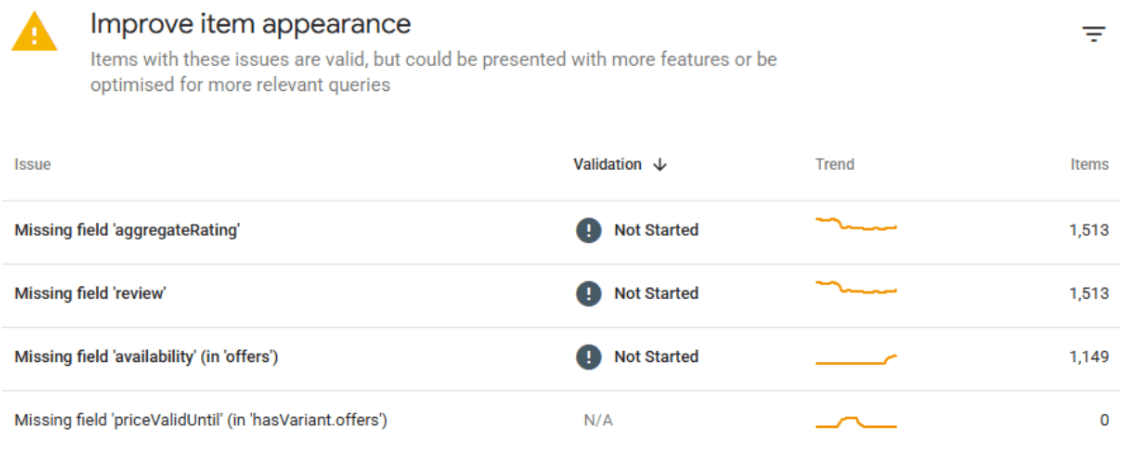
Product Snippets
The Product Snippets report validates your structured data implementation and highlights missing or invalid schema that may prevent rich product understanding.
Index Coverage
Ensure important product pages remain indexed and accessible.
Although Search Console doesn’t yet report on AI visibility directly, maintaining healthy structured data remains one of the strongest indicators of technical readiness – and, reporting of AI citations is likely to become a feature in the future.
Product analysis in Google Merchant Center
Merchant Center provides valuable insights into the health of your product catalogue. This product catalogue is one of the most important parts for the AI in terms of product discoverability. As such, your shopping feed needs to be reviewed often, to ensure your data quality remains as high as possible.
In particular, regularly review:
- Product approval status
- Missing attributes
- Data quality issues
- Product diagnostics
- Best-selling products
- Underperforming products
- Feed errors
- Stock and availability
- Pricing inconsistencies
Maintaining high-quality product data not only helps to improve discoverability on Google’s shopping systems, but it also provides vital product information and context that can support visibility in AI search platforms.
Issues such as pricing or stock inaccuracies can be a major issue which if not addressed can result in your shopping feeds underperforming, or being removed altogether.
Performance metrics in Merchant Center
Google has also begun introducing AI Performance Insights within Merchant Center, providing retailers with visibility into how products are being discovered throughout AI search shopping experiences, including AI Mode and AI Overviews.
The report includes metrics such as:
- Share of Voice
- Shopping journey stage (Discovery, Evaluation and Purchase)
- Popular product searches
- Product attribute opportunities
- Product visibility trends
This data can also be filtered by category and location, so will be invaluable data for spotting optimising opportunities or underperforming products.
Although availability is currently rolling out across markets and only covers Google/Gemini AI search models, this is likely to become one of the most valuable reporting tools for measuring Ecommerce GEO over time.
Alongside traditional ecommerce KPIs such as revenue, conversion rate and organic traffic, these visibility and share of voice metrics will provide a much more complete picture of your readiness for GEO ecommerce.
How Varn can help
AI search is changing rapidly, but the businesses that perform best won’t be those looking for shortcuts or chasing every new feature.
The organisations with strong marketing foundations: solid technical setup, high-quality product data and a joined-up search strategy; will be the ones who come out on top.
At Varn, we help ecommerce businesses understand how search is evolving and what practical steps will deliver the greatest impact in both the short and the long term. There are very few quick wins, and with AI search creating a total evolution in search, you need a strategic proactive partner to keep you ahead of the competition.
Whether you’re beginning to explore Ecommerce GEO, or looking to strengthen your wider digital marketing strategy, our team can help you prioritise the opportunities that matter most for your business.
If you’d like to discuss your ecommerce search strategy or understand how well optimised your website is for AI search, get in touch with us today.

Do you need GEO expertise for your ecommerce brand?
Get in touchEcommerce GEO (Generative Engine Optimisation) is the process of optimising an ecommerce website so that AI-powered search engines and assistants can understand, trust and recommend its products. It builds on traditional SEO by focusing on information presented in shopping feeds, product structured data, descriptive information, and technical accessibility.
Yes – but the fundamentals of ecommerce SEO will help support your performance in ecommerce GEO.
Traditional SEO helps your products rank in search engine results pages, and typical optimisation methods include creating product descriptions that are optimised for search. This kind of optimisation work supports AI by providing further information about the product, therefore making it easier for AI search to recommend those products when users ask conversational questions.
Many of the same technical SEO principles still apply, but GEO places greater emphasis on structured product data, Merchant Center optimisation and machine-readable content.
Start by auditing your product data.
Ensure your products have:
- Complete Product schema markup
- Accurate pricing and accurate stock availability
- GTINs and product identifiers – people often search by SKU or GTIN
- High-quality images
- Detailed product descriptions – AI needs as much information as possible
- An optimised Merchant Center feed
Most ecommerce businesses already have most of these assets to some extent – they often just aren’t as complete or consistent as they could be.
There isn’t currently a single “AI visibility score”, so measuring readiness requires several data sources.
You should monitor:
- AI crawler activity through server log files
- Product schema health in Google Search Console
- Merchant Center diagnostics
- Product feed quality
- AI Performance Insights (where available)
Together, these provide a good indication of how prepared your website is for AI-powered search.
Potentially, but it’s also likely to increase the quality of traffic.
As AI answers become more advanced and users get more familiar with the technology, some informational searches may generate fewer clicks. However, ecommerce searches with strong purchase intent are still likely to result in users visiting retailer websites, especially when comparing products, checking availability or completing a purchase.
With AI search, it’s more likely that the user will visit the retailer ‘ready to buy’, because of the research they’ve been able to do, and the direction the AI has steered them in.
The focus should shift from simply maximising clicks to ensuring your products are visible wherever customers are searching.
You might also be interested in...
Agentic AI, AI & innovation 27.05.26
The shift to agentic shopping: How consumer behaviour is changing
Read more
Article by:
Agentic AI, Technical SEO 07.05.26
What is UCP? Preparing your store for agentic shopping
Read more
Article by: