You may have heard a lot of new acronyms floating around recently regarding Agentic Shopping. Essentially, these new protocols have been put in place to help facilitate the introduction of agentic search, and more specifically, agentic shopping.
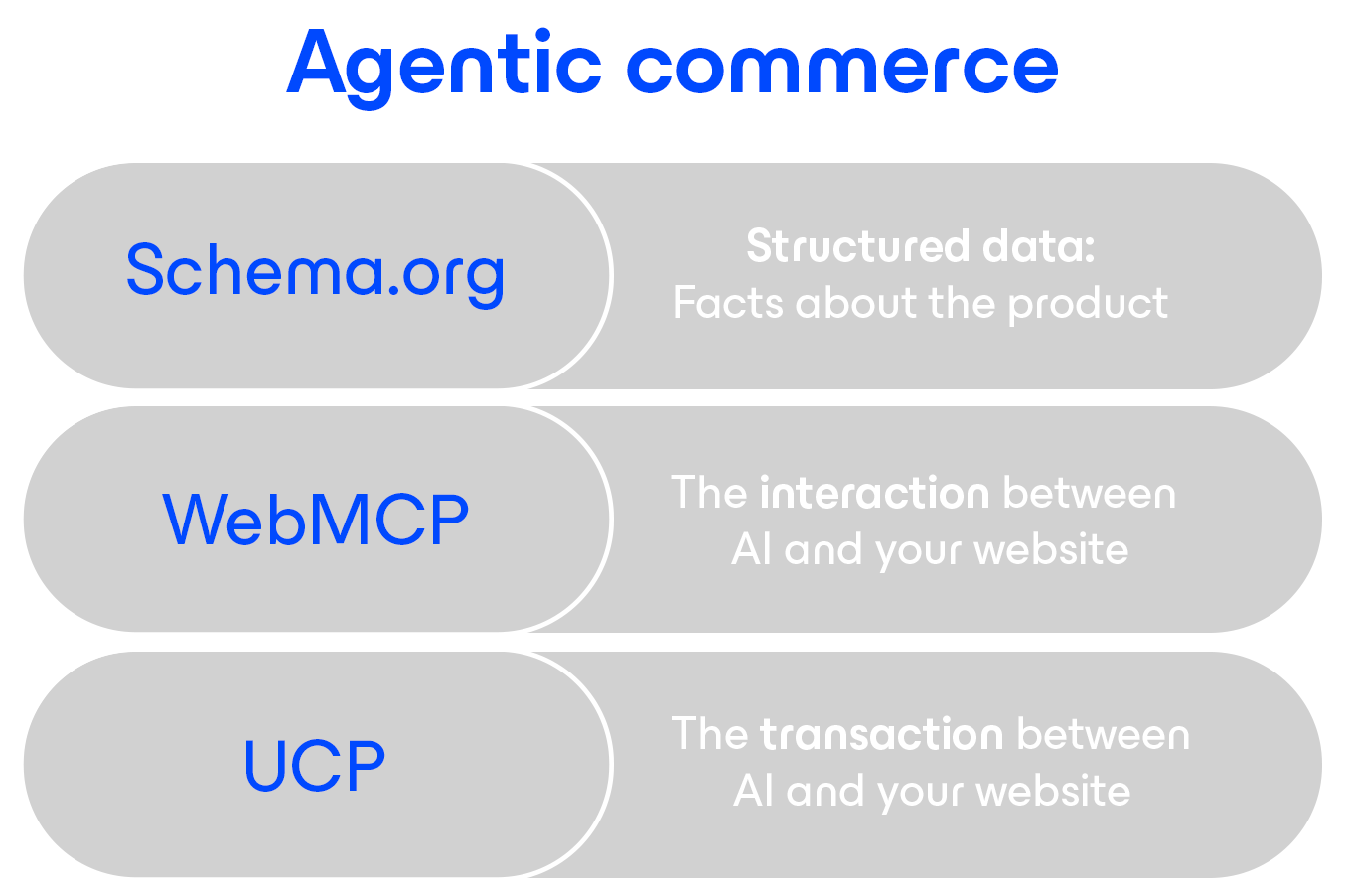
What is agentic shopping?
Agentic shopping means that users will be able to search for, browse, add to basket and purchase products through the interface of an AI chatbot platform. Google’s version of this is being built around UCP for AI Mode in Search and Gemini, while platforms such as ChatGPT are developing their own commerce protocols.
What is an AI agent?
An AI agent refers to a system which is able to act autonomously on behalf of a user. Traditionally a user would browse through a site looking for a product that fits their needs, compare it with other products on the site or on other sites, add the desired product to basket, then purchase it. The AI agent can perform these tasks on the user’s behalf from a single prompt, browsing, comparing, selecting, and in some cases, complete the purchase without the user ever needing to visit a single retailer’s website.
What does agentic shopping mean for e-commerce brands?
How you optimise your online store for consumers is changing; it is not just about appearing first in organic search or just having some citation in AI platforms. You need to make sure your product feeds are accessible, optimised and set up correctly so that users can purchase from your store from these platforms, without having to enter your site. Otherwise, you will be missing out on a growing number of AI platform adopters.
A lot of the documentation around these new protocols may seem overwhelming and confusing, but they all act in the same function as any other protocol on the web. They make sure that different platforms and sites can understand each other and follow the same rules without having to both have a set integration. This means that it doesn’t matter what CMS you use or what AI platform your consumers may use, these protocols are setting up a situation where they can all communicate with each other seamlessly.
However, there are still actions you need to take to ensure you show up; it won’t all happen automatically.
So what actually is UCP?
UCP stands for Universal Commerce Protocol. It’s a Google-led open standard that gives AI agents a clear, structured way to understand what your store offers and how to buy from it. It was developed with Shopify, Etsy, Wayfair, Target, and Walmart, and endorsed by over 20 global partners, including American Express, Mastercard, Stripe, Visa, and Zalando.
Think of it like a handshake. When an AI agent goes looking for a product, it checks whether your store has a small file sitting at a specific location on your domain.
That file is your store introducing itself to the agent in a language it understands: here’s what we sell, here’s how to buy it, here are the payment methods we accept, here’s what we can do (checkout, discounts, order tracking, fulfilment).
If your store doesn’t have it, or if the information it contains is patchy, the agent may simply move on to a competitor that does.
If you want to see UCP in action, add /.well-known/ucp to the end of a homepage URL of (almost any) Shopify site, as they have set this up automatically across sites hosted on their CMS.
What if I don’t use Shopify as my CMS?
If you’re on WooCommerce or another platform, this file won’t exist automatically; it needs to be created and configured. That’s a conversation worth having with your developer now, before Google’s AI shopping surfaces become more prominent and you’re playing catch-up.
This is not where your individual product information is held, this file is simply providing information about your store that the AI crawler needs to know.
Why having a UCP file is just the beginning
This is where it gets important for marketers and website managers. The file itself is just one step in the process. What really determines whether an AI agent surfaces your products is the quality of the information behind it. Product data quality also affects whether a transaction completes at all, not just where you rank in AI platforms.
How to prepare for Agentic Shopping
Your Google Merchant Centre account
This is essential to get set up and optimised for your site. For Google’s agentic shopping ecosystem, Merchant Centre is becoming the foundation. If your account, feed and product attributes are incomplete, your chances of being surfaced or selected are likely to be severely limited. Furthermore, Google has released new data attributes, which are key to getting your product surfaced for relevant queries. At the moment, the UCP settings in the merchant centre are only available in the US, and you need to request this by joining the waitlist for US vendors. However, if you are not based in the US, you can still start preparing your merchant centre today for these upcoming changes, as Google has stated it plans to expand globally over the coming months.
Schema markup
AI agents don’t browse your website the way a human does; they read structured data instead. Specifically, they look for schema markup. Schema markup communicates clearly what is on a page to a crawler, for instance, product information. Most e-commerce sites have some product schema in place. Very few have it implemented to the standard that agentic commerce requires. Auditing, implementing, and maintaining schema across a full product catalogue, especially one with hundreds or thousands of SKUs, is complex but is a high priority for agentic ecommerce. If it is not optimal, an agent simply cannot match you to a relevant query, and you will be excluded from the transaction entirely.
Real-time product feeds
UCP now supports agents pulling live data, current pricing, live stock levels, and accurate variant availability. If your feeds are only updated once a day (or less), you risk agents recommending products you can’t fulfil, or missing out when a competitor’s live feed shows availability that yours doesn’t.
Consistency across platforms
If your product information looks different on your own site versus Amazon, Google Shopping or other retailers, AI agents will notice. Those inconsistencies could work against you; they create doubt about whether the data is accurate, and agents may favour merchants whose data is consistent everywhere. It is important to audit all the different channels you sell through and what product data they are presenting. Additionally, if there is a cheaper version of your product somewhere, AI crawlers could find it and recommend it.
What about the actual payment process?
UCP is designed to handle the full journey: discovery, product selection, and completed transaction. However, the last step, the payment, is not fully adopted with UCP alone.
This step requires an additional security layer called AP2 (Agent Payment Protocol). AP2 uses cryptographic signing to verify that payment instructions are legitimate and haven’t been tampered with. UCP is designed to support checkout directly on Google surfaces while keeping the retailer as the merchant of record.
However, this is not yet widely implemented and at the moment, payments are still, in most cases, happening on the shop’s website. UCP is focused on eligible US retailers at the moment and uses saved payment credentials in Google Wallet, with PayPal support planned. For wider agent-led payments, Google’s AP2 provides the additional security layer for proving user consent and authorising payments. It is worth being aware that this will likely roll out more widely soon. OpenAI has been testing this, and Shopify has been starting to facilitate this through options in their CMS.
Summary
You don’t need to understand every technical detail of how UCP works to optimise for and prepare for this new era of online shopping. But knowing the priority areas to focus on is key. There is a lot you can already start doing.
The stores that will perform well in agentic commerce are not necessarily the biggest or best-known; they are the ones whose data is well-structured, cleanest, most complete, and most consistent.
If you want to know exactly where your store stands, and what needs to happen to get it ready, our Agentic Shopping Readiness Audit gives you a clear, prioritised action plan for making your store visible and transactable to AI agents.

Is your website set up for agentic shopping?
Get in touchYou might also be interested in...