The rise of agentic conversions
For years, consumers have used search engines, social media and websites to research products before buying them. Now, AI agents are starting to take on some of that work for them.
As well as recommending a product or providing a link, an AI agent can research options, compare products, navigate retailer websites and complete the transaction once the consumer approves.
This creates a new type of conversion: an agentic conversion, which, in turn, raises a measurement question: how do you identify a conversion when the person making the purchase isn’t necessarily the person interacting with your website?
Where can agentic conversions occur?
Agentic conversions can happen wherever an AI agent can interact with a business’s digital services.
For example, a consumer might ask Meta Muse (or any other AI agent) to find a particular product within a certain budget. With the consumer’s approval, the agent could then buy it from a suitable retailer’s website. The retailer still gets an order, and the customer still gets a confirmation email and order number. The journey, however, is very different from a customer visiting the website directly.
This is particularly relevant for ecommerce businesses, but other businesses could also see agent-led enquiries, bookings and transactions as AI agents get better at interacting with websites and digital services.
How are agentic conversions tracked on basic GA4?
GA4 is essential for understanding website performance, including where visitors come from and which marketing channels generate conversions. Most of our clients use it, and it’s great for benchmarking day-to-day performance, but it has limitations.
One potential blind spot is agentic activity.
When we examined purchases made through an AI agent (Meta’s newly launched Muse), standard GA4 reporting attributed the conversions to Direct traffic.
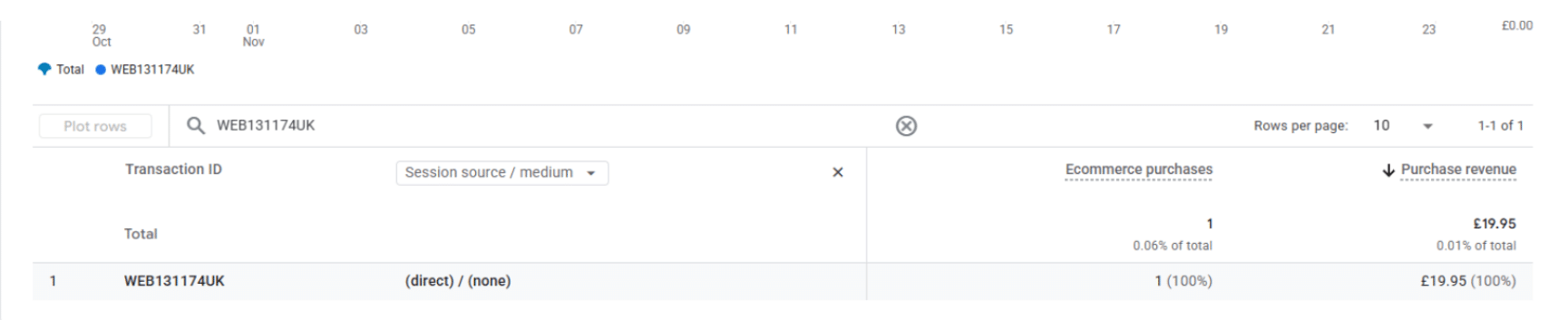
Direct traffic typically means someone has typed your website address into their browser, used a bookmark or arrived through a journey where referral information is unavailable.
For a purchase completed by an AI agent, that label doesn’t tell the whole story. The AI platform may technically have visited your site ‘directly’, but the user journey isn’t the same as that of a customer who navigated there themselves.
GA4’s standard reporting doesn’t always have the information needed to identify that source correctly, so you could be making sales through AI agents without seeing them as a distinct acquisition channel in your usual reports.
If those conversions are grouped into Direct traffic, it’s difficult to tell how much revenue AI agents generate and whether it’s growing. That’s particularly important if you’re investing time and money into AI search optimisation and want to attribute revenue accurately.
How to overcome the tracking issue
One way to investigate this further is through Google BigQuery.
BigQuery is Google’s data warehouse platform, and you can connect it to GA4 to export website event data. Standard GA4 reporting presents processed, organised information. The BigQuery export gives you granular, event-level data for much more detailed analysis.
We recommend BigQuery to all our clients, and we used this integration to investigate agentic conversions in more detail.
In our testing, we found additional information associated with the transactions, including an App Name value of ‘Meta AI and Muse’.
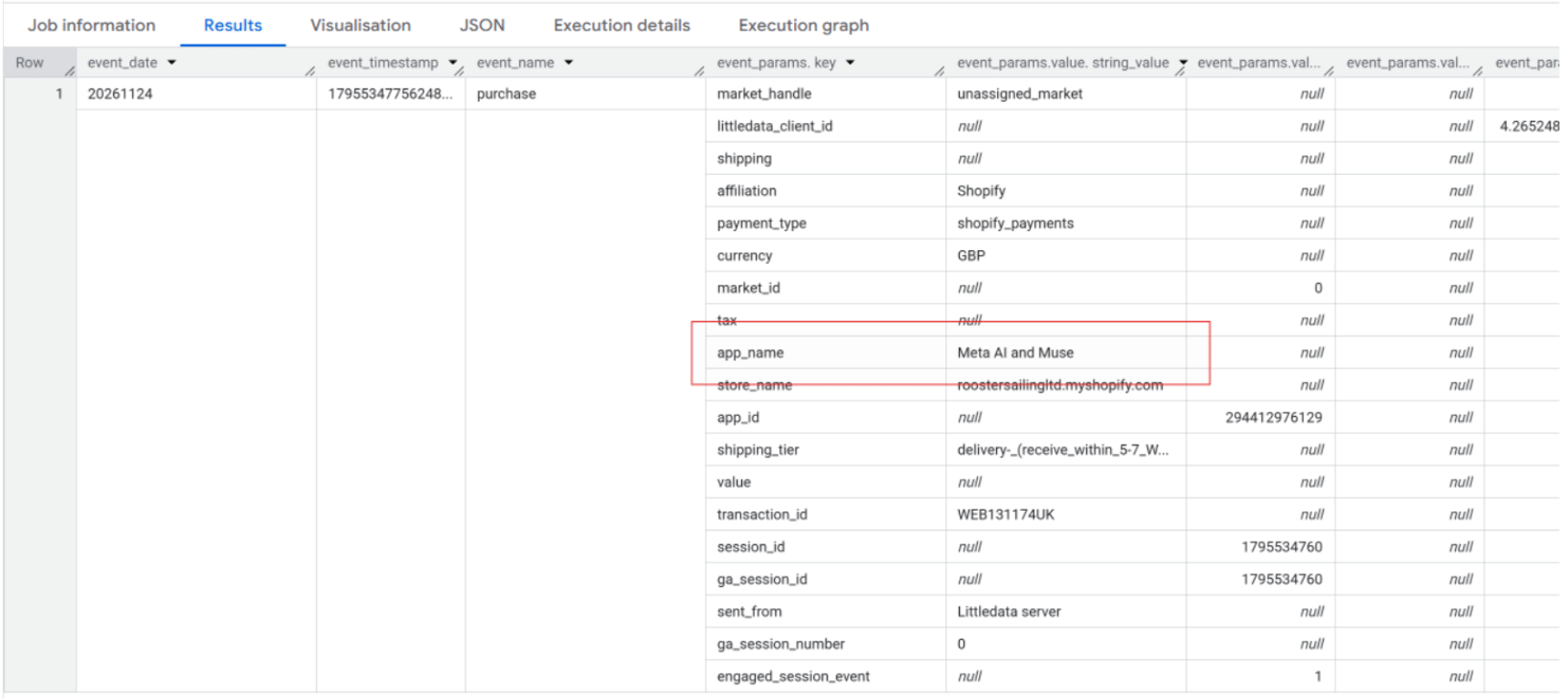
This identified activity that standard GA4 acquisition reports weren’t clearly distinguishing.
Behind a ‘Direct’ conversion, we could see its association with Meta’s AI environment.
We can then set up our own reporting to treat it as an agentic conversion. Every time we see an ‘app_name’ of ‘Meta AI and Muse’, we can automatically group that visit or conversion as ‘agentic’.
How can businesses use this data to improve their marketing strategies?
Good marketing decisions depend on accurate conversion data.
If AI agents are starting to generate sales for your business, knowing what they contribute could shape several parts of your marketing strategy. That applies especially to ecommerce, but as agentic use grows, it will apply to any business.
1. Understand the commercial value of AI agents
Identifying agentic conversions lets you start measuring how much revenue AI agents generate.
You can treat them as a distinct source of commercial activity, separate from Direct traffic. That’s useful for reporting return on investment to your board, or tracking how agentic purchases grow over time.
2. Identify which AI platforms are generating conversions
AI platforms won’t necessarily all generate the same level of activity. Knowing which ones are involved shows where agentic commerce is developing and which platforms deserve closer attention. If you rely on paid traffic to drive sales, it can help you distribute your spend more effectively.
3. Inform your wider GEO strategy
Generative Engine Optimisation (GEO) focuses on improving how brands and their content appear across AI-powered search and discovery platforms.
Knowing which AI platforms generate actual transactions adds another dimension to this strategy. Some might help more with discoverability, while others, particularly agents, might be more of a commercial driver.
You can start to investigate whether your presence across AI platforms is contributing to commercial outcomes.
It can help businesses move beyond simply measuring visibility and begin investigating whether their presence across AI platforms is contributing to commercial outcomes.
4. Make better investment decisions
As new AI platforms and agentic services emerge, you’ll need to decide where to prioritise your marketing resources.
Without accurate measurement, it’s difficult to know whether these channels are delivering value. Better data helps marketing managers decide where to invest their time and budget.
What next?
Without connecting GA4 to BigQuery, we wouldn’t have been able to identify the transaction as coming from an agentic platform at all. Now we can set up rules to keep tracking it.
With developments like Meta Muse bringing agentic commerce closer to mainstream adoption, now is a good time to review your tracking, before you’re playing catch-up.
At Varn, we help businesses with SEO and GEO, as well as data, tracking and analytics. If you’re struggling to understand how AI and agentic commerce are affecting your business, speak to us about our data and tracking audits.

Need help adapting for the agentic era?
Get in touchYou might also be interested in...