We’ve moved beyond the era of spamming hashtags. Instagram SEO is now an important channel for building online visibility, brand awareness, and encouraging conversions. Since July 2025, Instagram posts from professional accounts have been eligible to be indexed and appear in search, and therefore, by extension, AI too.
Instagram is often overlooked as part of a holistic SEO strategy; posts and profiles can win you valuable SERP real estate and increase visibility for your desired keywords in both traditional search and AI. Furthermore, an Instagram SEO strategy is also important for in-app visibility, helping to promote you and your content to new audiences through Explore and Search features.
If you’d like to explore Instagram as part of your SEO strategy, this handy guide should serve as a starting point.
How do I get started with Instagram SEO?
First things first, you need to check that your account is a professional one (either business or creator). Professional accounts are always set to public, which is also required for your posts to be indexable.
You also need to check that you are opted in to appearing in search – you can do this under Account Privacy settings. Ensure the toggle for “Allow public photos and videos to appear in search engine results” is on if you wish to be indexed.
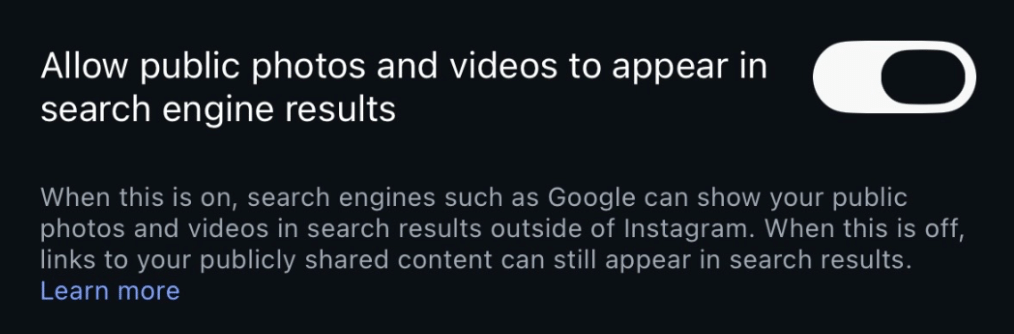
If either of these is not done, your posts will not be indexable, and no matter what you do, you won’t appear in search engines or AI search.
What content do I need to post on Instagram?
Focusing on Instagram SEO isn’t just the practice of adding some keywords into your bio; it needs to fundamentally shift how you think about your content going forward. SEO-optimised content naturally targets identified keywords, but also offers genuine value and shows your expertise. Spam content or content that has clearly only been created to target keywords does not offer genuine value, and often does not perform well in the long term.
When thinking about your Instagram content through an SEO lens:
- SEO-optimised posts will have better longevity than time-sensitive updates or short-term social content. Consider a balance of using your Instagram profile for updates (e.g. flash sale announcements) versus longer-form content. Posts can show up in search weeks, months, or years after posting, compared with the shorter lifespans seen on the app.
- Shift towards evergreen content – e.g. educational content with clear EEAT signals, thought leadership, and informative or educational posts. Consider what people will be searching for in relation to your offering – are these common FAQs/ misconceptions, recipes, tutorials, opinion/ commentary pieces, educational carousels or reels, or product explainers (etc.)?
- Posts need to offer genuine value – don’t post just for the sake of it or just to meet a posting schedule. Consider the goal and intention behind each piece, and plan content around key topics or issues you can see people are searching for. For each post, can you think about the primary keywords it will target, the intended audience, the lifespan, and its relevance to your core offering?
- Focus on views, shares and saves rather than just likes. Focusing on just likes and comments as a signal of success may not work as well for SEO purposes: the goal is visibility.
Why focus on Instagram SEO?
Instagram can contribute to:
- Brand awareness: Having your profile and posts appear in search results (and more prominently in the app) will increase brand awareness, helping people to discover you and your offering
- Long-lasting traffic: Instagram content surfaced in search results is likely to be more evergreen than purely in-app content due to the differing algorithms
- Organic visibility: Growing your reach organically reduces your reliance on paid advertising and helps you build a free, organic stream of traffic
Furthermore, focusing on Instagram SEO can offer:
- Competitive advantage: If competitors aren’t focusing on Instagram SEO, this is an opportunity to get ahead and increase visibility.
- AI mentions: Because AI platforms pull in data from search results, Instagram content that is served in search is eligible to be served in AI answers.
Instagram SEO: The basics
When looking at Instagram SEO, start off with these account optimisation fundamentals:
- Display name: Add keywords where you can – e.g. “Bakes By Jordana | Vegan Letterbox Cakes”
- Username/ handle: Make it simple and searchable, aligned with your brand name. For example, @bakesbyjordana rather than @jordana12345
For both of the above, consider that Google will list your Instagram profile in the SERP based on your handle and display name. What do you want to show up for?
- Bio: State who you are and your core offerings in the language people will be searching, and use keywords naturally
E.g. “Mom of two posting realistic workout plans for busy women” rather than “Be the best version of yourself ❤️”
- Location: Add your location to your bio if relevant (especially important for local businesses!) – this could be an address, or just the city or area you operate in.
- Category: Ensure you have selected the correct profile category (e.g. artist, coffee shop, marketing agency) as part of your professional account. This will instantly communicate to visitors your expertise and help Instagram recommend you to the correct audience.
- Google Business Profile: Ensure you have linked your Instagram account to your Google Business Profile.
Instagram SEO: How to optimise content
Now your account basics are sorted, it’s time to look at optimising your Instagram content.
- Captions: Ensure you have naturally incorporated key search terms within the first few lines. Avoid “keyword stuffing”, whereby keywords are forced in. If it helps, try speaking your caption aloud to see if it flows naturally. Add a CTA for engagement, whether this is an idea for a comment or a call to check out a link in your bio.
- Alt text: While putting together your post, click through to Advanced settings > Write alt text. Here, you can add alt text to your posts (including individually for multiple photos). You can also add or edit alt text for existing posts; just click Edit > Edit alt text. When writing alt text, try to add your keywords in naturally. Instagram uses this for additional context, accessibility AND for search indexing – use it!
Note: Instagram will automatically generate alt text if you leave this blank, but this is a wasted opportunity.
- On-screen text: Instagram reads the text overlay in reels, meaning any text becomes searchable. Ensure you consider a balance between keywords and attention hooks for your reel’s text. This appears to be weighted heavily, so ensure you use your main keyword in the first frame. Also note that reels with clear topics and keywords are easier to categorise.
- Subtitles: Ensure these are added to reels and videos. This not only helps with accessibility but can boost retention too, which all helps with the algorithm.
- Hashtags: Use a few (3-5) highly specific ones. These are still important, but are no longer the primary discovery method on Instagram.
- Consistency: Ensure your posts are on similar topics/ themes – this is easier if you are a brand, but consider where random engagement bait or unrelated posts may harm the perception of your content.
- Location tagging: If relevant, tag the location of your posts. This is especially important for local businesses or brands trying to build a local presence.
How do I know what keywords to use?
Before you even begin optimising your Instagram account, it is important that you have defined your target keywords and audience. To start, think about the keywords or search phrase you would like your content to appear for – for example, “festival outfit ideas”, “healthy meal prep”, “financial advice for early 20s”, etc.
This will give you an idea of the kind of keywords you’d like to be targeting. To refine this initial set of ideas, we need to cross-reference this with what people are actually searching for. This can be done through:
- Instagram search bar: This is a great way to see what people are actually searching for on Instagram itself. Simply start with a seed keyword in the search bar, and see what suggested searches come up for keyword ideas.
- Google Trends: Use the Google Trends tool to see an easy visualisation of relative search interest for a term on Google. This is a great way to see if people are searching for your target keywords, and for you to spot any seasonal trends around search behaviour that you can better align your content strategy with. Filter by location, date, and search type for even more detailed insights.
- Keyword research tools: If you have access to any keyword research tools (e.g. Semrush or Ahrefs), these are also a great (but not necessary!) place to find keywords and associated average search volumes.
How do I measure success?
It’s all well and good to optimise your Instagram content for SEO, but how will you know if it’s actually working?
The easiest way to see how your Instagram content is performing in search is to connect your Instagram account to Google Search Console. This will display the search queries people are using to find your content, alongside impressions and clicks (similar to traditional SEO), displayed in the same format as GSC data for websites.
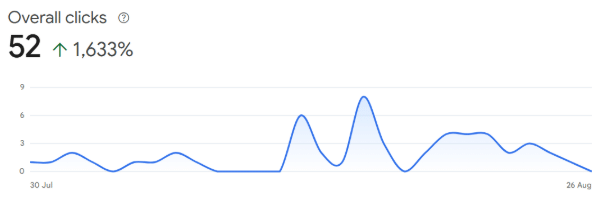
While Instagram does not have keyword rankings or traffic in the same way search engines do, there are a few key things you can keep an eye on to see if your optimisations are working:
- Profile visits and post views (especially from non-followers)
- Engagement (especially from non-followers)
- New followers
- Number of views with “Search” as the source for individual posts
- Reel insights
If you’d like to refine your performance data even further, you can:
- A/B test captions: Try A/B testing caption variants for reels to see what has the best visibility
- Review top-performing content: See what content has worked the best in terms of search/ explore visibility and identify any patterns
Instagram SEO: A Conclusion
Instagram is becoming an ever-increasingly important part of a holistic SEO strategy in 2026, and a viable channel to further increase reach and occupy space in the SERPs. Fundamentally, the principles are the same as traditional SEO, with a focus on identifying keywords, optimising your content and profile for these, and measuring success to inform iterative content improvements. The focus has simply shifted from websites and webpages to profiles and posts – which means slightly different implementation strategies. Optimising your content to appear in both search engine results and also more prominently in in-app search is a great way of increasing views, brand awareness, and attracting an organic audience without the need for paid ads, which is a great long-term strategy.
If you would like a hand with Instagram SEO, then Varn is more than happy to help. Get in touch to chat about your Instagram SEO strategy and how we can support.

Do you need SEO/GEO expertise to get visible online?
Let's talkYou might also be interested in...