What is WebMCP?
In simple terms, Model Context Protocol (MCP) is an open standard that acts like a “USB-C port” for AI. Just as a USB-C cable allows any device to connect to any charger, MCP (and WebMCP) allows any AI model (e.g. ChatGPT) to plug directly into your website’s data and perform specific actions (like filling out a form or making a booking).
Before MCP, if you wanted ChatGPT or Claude to, (for example), book a holiday on your website, you had to build custom code for every single AI platform. MCP replaces those bespoke connections with a universal language that any LLM can use.
It’s no longer just about being found by a human on Google; it’s about being understood and utilised by an AI agent – and MCP is one way to better ‘spoon feed’ LLMs and allow them to properly ‘use’ your website.
MCP vs. WebMCP: What’s the difference?
Before we dive into the mechanics, it is important to distinguish between the core protocol and its web-facing sibling. While they share a similar name, they perform different functions. In simple terms, MCP is for ‘back end’ information (database information), while WebMCP is for ‘front end’ information (the website the user is looking at).
MCP: This is the universal standard that allows an AI model to connect to your backend databases, files, or local software. It typically requires a server to sit between your data and the AI.
WebMCP: This is a specialised version designed specifically for the web browser. WebMCP allows your website to “talk” to an AI assistant directly while a user is browsing your page and help the AI navigate through, for example, a booking process.
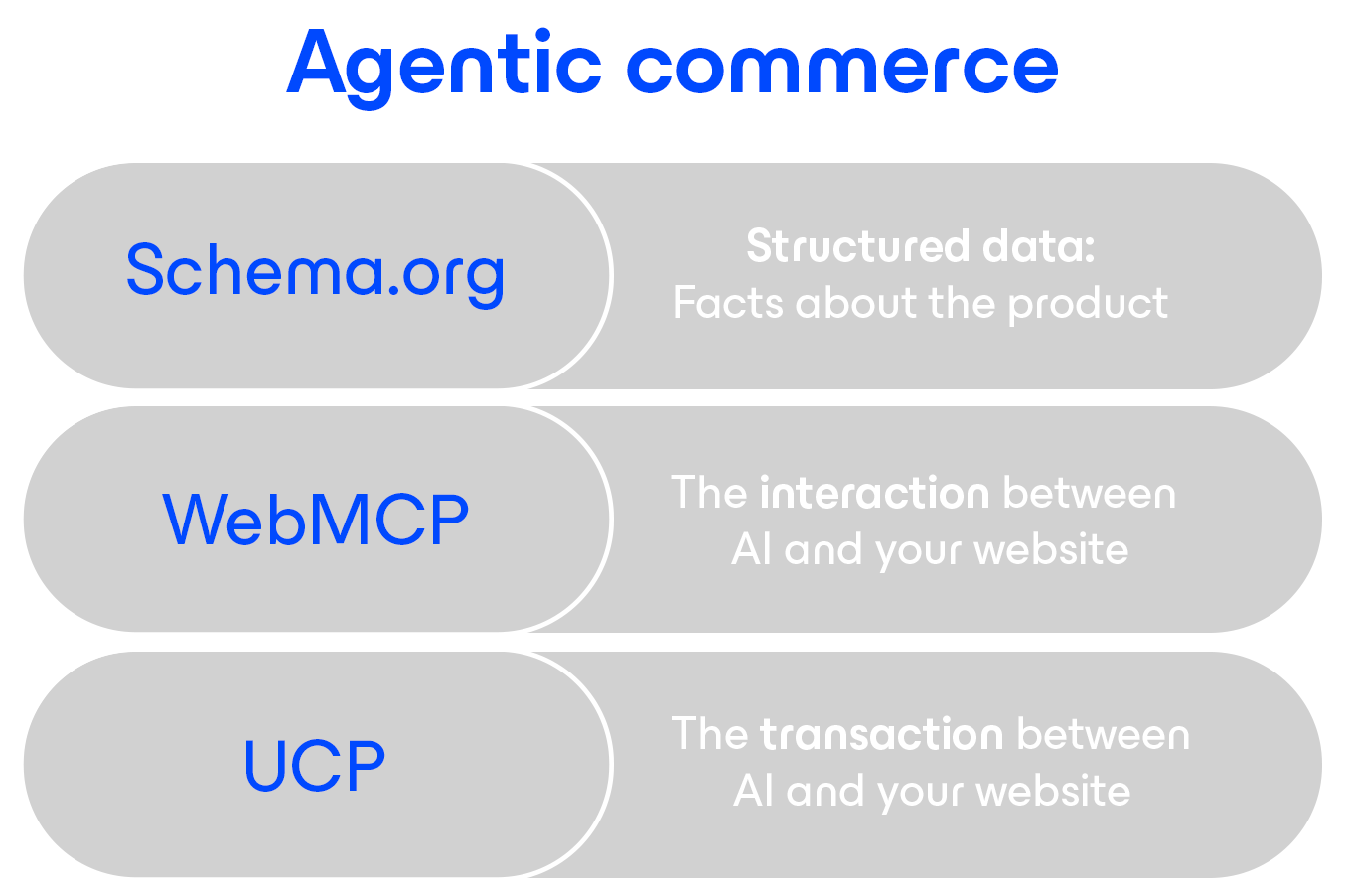
MCP vs. UCP: While MCP acts as a method for agents to interact with elements on your website (like a booking form), there is also Universal Context Protocol (UCP) which focuses on standardising the ecommerce experience for users (like buying a product)
Why is WebMCP important?
In the first example, the AI has collected the information, but the human still has to perform the action. With WebMCP, the AI can perform the action too.
By implementing WebMCP, you aren’t just giving the AI information to “read”, you are giving it “tools” to execute actions as well.
This is vital for the growth of websites in AI search for a number of reasons:
- It only needs to be implemented once: It’s future-proof, providing information to all AI platforms and if implemented correctly, should rarely have to be tweaked.
- It reduces friction: Users can make a booking without ever leaving their AI assistant.
- It ensures accuracy: The AI pulls live data (like actual room availability) rather than guessing from an old cached version of your site.
- It captures “Agentic” traffic: As more people use AI agents to plan and execute tasks, websites without WebMCP integration will simply never be available to these types of buyers.
Which LLMs support MCP?
Most major AI providers are already supporting MCP to ensure website owners can use the same protocol and be visible across multiple AI platforms.
- Claude (Anthropic): The creator of MCP, Claude has supported MCP since November 2024
- ChatGPT (OpenAI): Supported since September 2025.
- Gemini (Google): Supported since December 2025.
- Perplexity: Supported since March 2025.
- Grok: Supported since July 2025.
Note: Because MCP is an open standard, any new LLM can adopt it instantly, making your one-time implementation future-proof.
How does WebMCP work?
To understand how this works in practice, let’s look at a user trying to book a holiday as a good example:
- The Prompt: A user tells their AI assistant, “Find me a 4-person cottage in Cornwall for the first week of July under £1,500 and start the booking”.
- The Handshake: Your website sends a signal to the AI saying: “I am WebMCP-enabled. I have a ‘Check Availability’ tool and a ‘Reserve Cottage’ tool available for this page.”
- Context Sharing: The website uses WebMCP to feed the AI the “context” – the cottage name, price per night, and current calendar status.
- AI to User: The AI feeds the information back to the user: “I’ve found this cottage, it’s within budget and available for the first week of July, would you like me to book it for you?”
- Seamless Conversion: Upon confirmation from the user, the AI then triggers the “Reserve” tool, pre-filling the user’s saved details into your booking form.
The above, seamless process, is expected to transform the experience of many types of website – in particular, booking platforms – and, if your website isn’t ready for it, it simply won’t be available to these types of users.
Is MCP different to A2A?
You might have heard of A2A (Agent to Agent) and thought that this is quite similar. They are different though, and the distinction is important for your strategy.
A2A (Agent-to-Agent) is the protocol used when two AI “agents” talk to each other (e.g., a user’s personal travel bot talking to your company’s customer service bot).
In comparison, MCP is the protocol that allows any of those agents to access your underlying database, without the need for another agent to do the heavy lifting.
Think of A2A as the “conversation” between two people deciding what to order, while MCP is the “menu” that an AI agent looks at to make their own choice.
How do I get WebMCP on my own website?
Implementation is a technical process, but the marketing strategy behind it is what drives ROI.
Because the web version of MCP (WebMCP) lives on the “frontend” (the part of the site the user sees), the setup is focused on making your website’s existing features understandable to a browser-based AI.
At Varn, we follow a structured framework to get you “Agentic User Ready”:
- Step 1: Action Mapping: We identify the key “conversion tools” on your site (e.g., booking forms, quote calculators, or store finders) that should be exposed to the AI.
- Step 2: WebMCP Script Deployment: We add the necessary scripts to your website’s code. This allows your site to broadcast its capabilities to the user’s AI assistant, and is deliberately lightweight in order to not impact page load times.
- Step 3: Tool “Descriptions” (Metadata): We write the technical descriptions that tell the AI exactly when and how to use your tools. This effectively describes each of the available functions so the AI knows when to use them.
- Step 4: Secure Handshaking: We make sure that the AI can only perform actions (like bookings) when the user gives explicit permission.
- Step 5: Browser Assistant Testing: We test the integration across various AI platforms and browser extensions to ensure the customer journey is flawless and the data being passed is accurate.
Ready to move from 'searchable' to 'actionable'?
If the acronyms above are confusing, we can help direct you towards what exactly you need to show up in agentic search.
The shift to agent-led commerce is the biggest change to the web since the mobile revolution. At Varn, we specialise in the technical and data frameworks that ensure your brand has the edge to be ahead of competitors in agent-led search.
If your website is an ecommerce brand, we have a dedicated Agentic Shopping Readiness Audit, perfect for getting you ready for agentic search. For lead-gen brands, the approach is much the same, but requirements are slightly more bespoke.
Get in contact with our team today for a free consultancy call, and we can identify what solution would work best for you.

Is your website set up for agentic shopping?
Get in touchYou might also be interested in...
AI & innovation 28.07.25
How ChatGPT’s agentic AI is changing SEO, and what you should do about it
Read more
Article by:
AI & innovation, SERP 31.03.25
Entity SEO: Get your brand seen in Google & AI search
Read more
Article by: